
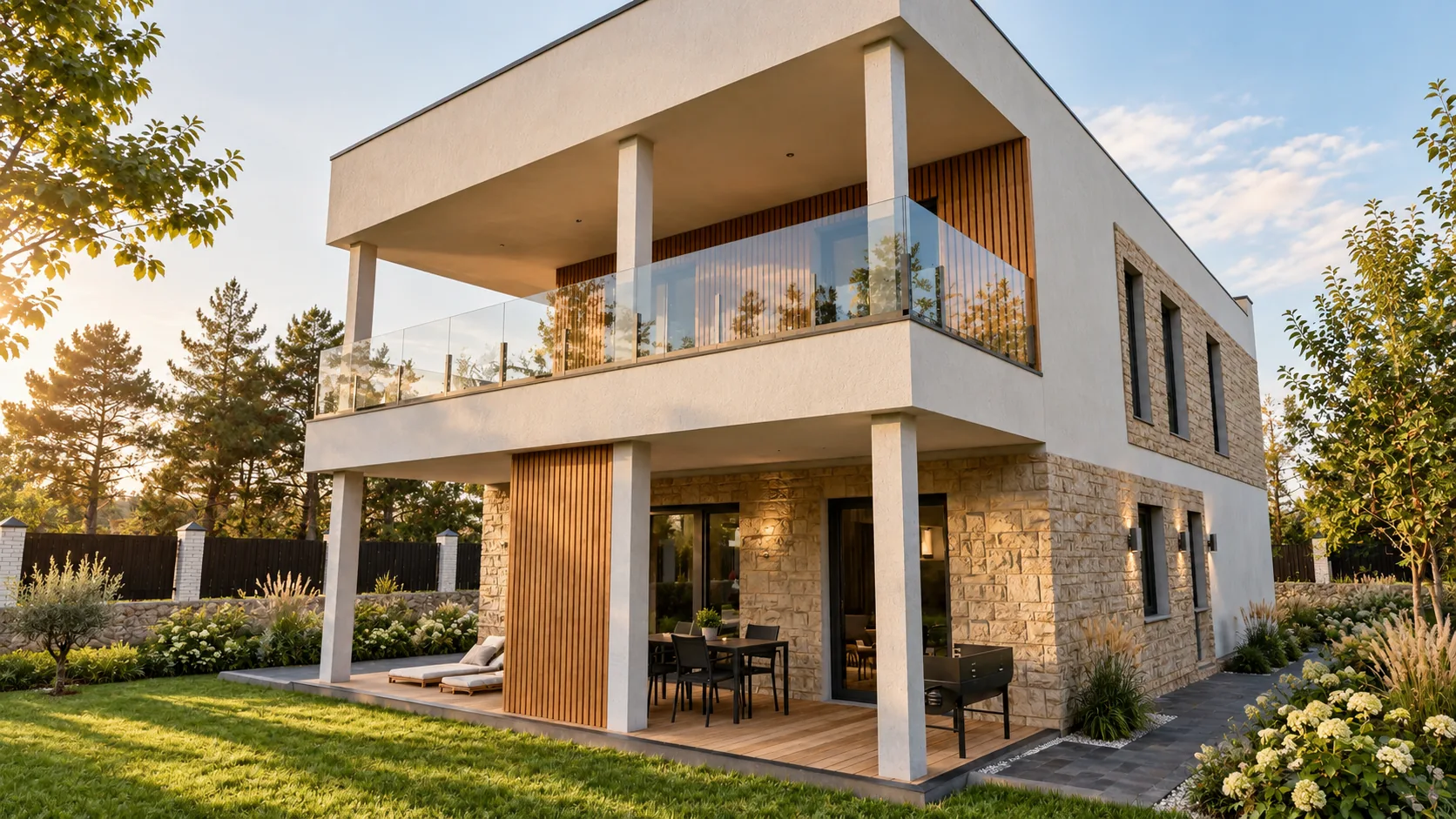
A golden hour house rendering works because the sun is low, somewhere between 5 and 20 degrees above the horizon, and coming from the side. That one change gives you long shadows that describe the shape of the building, warm light on the facade and a cooler sky behind it. Put the same house under a noon sun at 60 or 70 degrees and every wall facing the camera gets the same flat wash of light. It looks like a site survey photo.
Most of my exterior work ends up in that low-sun range now. Not all of it, though.
Why noon looks flat
Shadows are what tell your eye that a facade has depth. A window reveal of 150 mm, a roof overhang of 600 mm, the step between a render band and timber cladding: at noon those cast short, nearly vertical shadows, a few centimetres wide, and they mostly disappear at viewing size. The building reads as a cardboard cut-out.
Noon also kills colour contrast. The direct sun and the sky are both bright and fairly neutral, so the lit side and the shaded side end up with the same cool-white cast, and the sky in the background is a pale blue that's close in value to a white wall.
Nothing separates.
Lower the sun and three things happen at once. Shadows stretch, so every reveal and overhang draws a line. The direct light warms up (think 3000 to 4000 K rather than the 5500 K or so you get at midday) while the shaded side picks up the blue of the sky. And the sky itself darkens near the top of the frame. Warm against cool, light against dark. That's most of the effect.
The sun angle I actually use
Here's the counter-intuitive bit: real golden hour is usually too much.
At 2 or 3 degrees the light is deep orange, the shadows cross the entire garden and half the facade sits in shade. It's beautiful for about ten minutes in a photograph. In a render that a buyer studies for the materials, it hides the cladding colour and turns white render into peach.
So I mostly sit between 10 and 18 degrees of elevation. That's the light you'd get roughly an hour to an hour and a half before sunset, warm but not saturated, shadows long enough to show the overhangs but short enough that the lawn still reads as green. In Blender I drive it with the physical sky model and a sun lamp, then tune the elevation in one-degree steps, because two degrees really does change the mood.
Azimuth matters just as much. I want the sun 30 to 60 degrees off the camera direction, raking across the main facade. Straight behind the camera is flat again (front light, no shadows you can see). Straight into the camera gives you a dramatic silhouette and a facade in deep shade, which is lovely for a magazine cover and useless for selling a house.
Orientation: how much you can cheat
If you send me a site plan with a north arrow, I can place the sun where it really is on a given date and time. Sometimes that's exactly what you want, especially when the selling point is "the terrace gets evening sun". Often, though, the real sun is in the wrong place. A house whose street facade faces north-east won't get warm evening light on that side for most of the year. I'll tell you that. Then we decide together whether the image is a mood picture, where I'm free to rotate the sun, or an honest one, where the light matches the site.
My rule: if buyers will stand on that terrace before they sign, don't invent sunlight they'll never see there. If the image is for a planning presentation or an early brochure where the point is the architecture, a cheated sun is fine, and I'd rather mention it in the brief than pretend.
What else changes when the sun drops
So is the sun the whole trick? Not quite. Low light exposes every weakness in the scene, and that's where the hours go.
- Vegetation. Backlit leaves glow, so trees need proper translucency or they turn into black blobs. This is the single biggest jump in render time on a golden hour exterior.
- Glass. Low sun hits windows at a grazing angle and they turn into mirrors. I often add a few interior lights at low power so the glass shows depth instead of a bright reflection of the sky.
- Ground and shadow edges. Long shadows on gravel or a lawn show whether the ground has real texture. A flat green plane looks like carpet.
- Exposure. The range between the lit facade and the shaded side is wide, so I expose for the lit wall and let the shade fall off rather than lifting it until everything is grey.
Render time follows. A 4000 px exterior with a couple of trees and a hedge typically takes me 40 to 90 minutes per frame in Cycles, against maybe half that for the same view at noon with less light bouncing through leaves. You don't pay per minute of render, but it's the reason I want the camera agreed before lighting starts.
A recent example
Last autumn I worked on a modular timber house where the first preview used the client's real orientation, and the main facade landed in shade at every useful evening hour. The cladding looked brown and dull. We rotated the sun about 70 degrees for the hero view and kept the true orientation for a second, quieter view of the terrace, so the brochure had both the mood shot and the honest one.
That second view cost an extra exterior view, and it was the one the buyers asked about on site.
What I'd do if it were my house on the brochure
Use the low sun for the main exterior, around 12 to 15 degrees with the light raking across the facade you're proudest of. Skip the deep orange sunset unless the brief is purely mood. If the real orientation fights the picture, decide openly whether you want truth or atmosphere, and if both matter, buy the second view.
And don't fall for blue hour by default. A twilight shot with glowing windows is great when the interior lighting is a selling point, but for timber, brick or stone the low sun still shows the material better.
You can see how this looks across different houses in the portfolio, and the modern cabin exterior study shows low light on timber in a forest setting. Pricing is simple: a first exterior view is from EUR 149, an additional exterior view in the same order is EUR 99, and the Full Project package (one exterior plus four interiors) is EUR 449, all listed on the architectural rendering prices page. If you send drawings or a model through the quote form, I'll reply with a non-binding quote and a suggestion for where the sun should sit. More detail on what's included is on the exterior rendering services page.